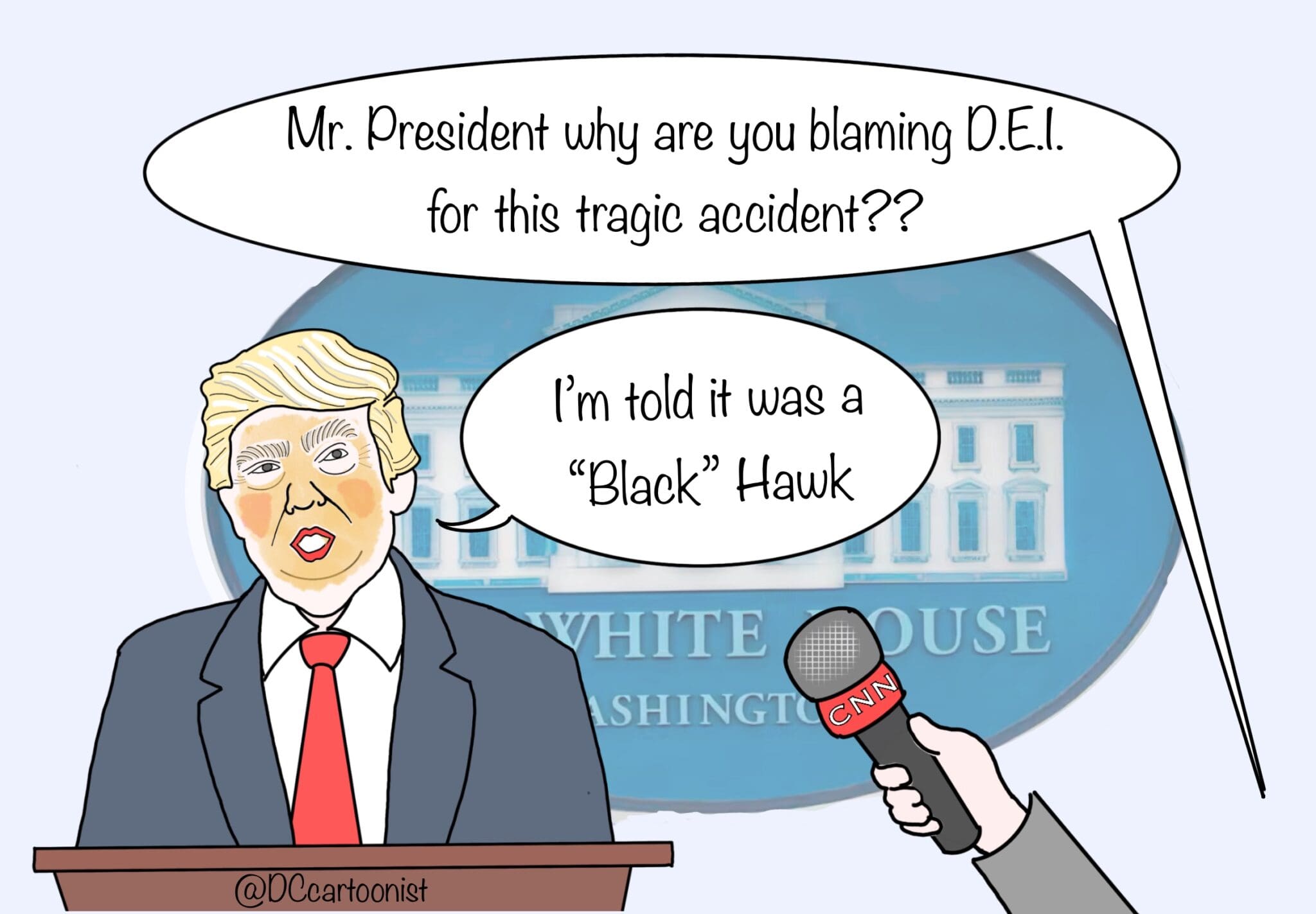
Blame D.E.I.
On Wednesday night, a Black Hawk helicopter collided with an airplane at Reagan National Airport, tragically killing everyone on board. It was a moment that demanded empathy, restraint, and leadership. Instead, it produced yet another tragedy: Donald Trump’s response.
Trump’s first instinct was not to mourn the dead or wait for facts, but to assign blame—specifically to diversity, equity, and inclusion initiatives. “The FAA is actively recruiting workers who suffer severe intellectual disabilities, psychiatric problems, and other mental and physical conditions under a diversity and inclusion hiring initiative spelled out on the agency’s website,” he claimed, without evidence and without regard for the people who had just lost their lives.
This has become Trump’s default reaction to nearly every crisis. Plane crash? DEI. Infrastructure failure? DEI. Complex systems fail, and Trump reaches not for understanding, but for a culture-war cudgel.
One of the most visible, and important, roles of the presidency is to serve as consoler-in-chief in moments of national grief. We’ve seen what that can look like when it’s done well: George W. Bush standing at Ground Zero after 9/11, or Barack Obama struggling through tears as he spoke about the children murdered at Sandy Hook. Those moments didn’t solve everything, but they mattered. They reminded the country that its leaders were human, present, and compassionate.
Trump fails utterly in this regard. Where others offered solace, he offers scapegoats. Where others sought unity, he sees opportunity. Tragedy, for Trump, is not a moment for reflection, it’s raw material to be exploited for political gain.
Leadership is revealed under pressure. And once again, Trump has shown that when the nation is grieving, he is campaigning.