Are Democrats Smarter Than Republicans?
My party is smarter than your party. If you don’t agree with me, you must be stupid. That’s what we all want to believe.
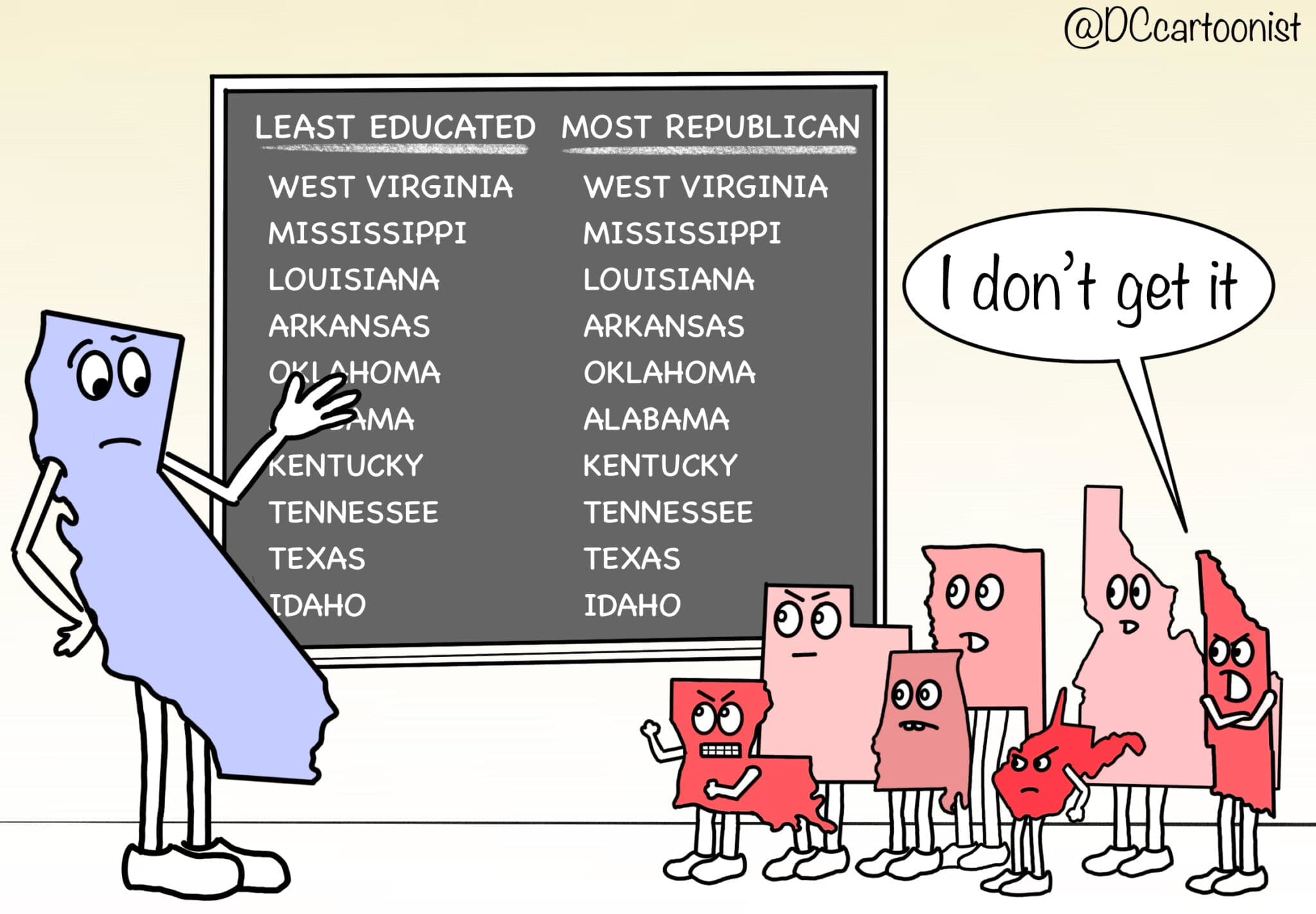
But is one party actually smarter on average than the other? One strong corollary to party affiliation is level of education. According to Pew Research in 2024, the Democratic Party has a 13-point advantage (55% vs. 42%) among those with a bachelor’s degree or more formal education. However, this data isn’t all that informative, because this education gap is a relatively recent switch. In 2008, Democrats had a double-digit advantage in affiliation over Republicans among voters without a college degree. If visual stereotypes help, Harvard and Yale are no longer churning out the sweater-vested, squash-playing Republican voters of the 1980s. Now their graduates are more likely to be caricatured as blue-haired liberals than blue-blooded conservatives.
So we see a correlation between advanced formal education and voting patterns, but does that mean Democrats are smarter than Republicans? Obviously, formal education does not equal higher intelligence. In fact, you often hear Republicans argue that for what they lack in formal credentials, they make up for with “common sense.” They are also quick to say that the university system is politically biased and indoctrinates the impressionable. Maybe they’re right—after all, surveys show that people who pursue postgraduate degrees lean even more liberal than those with just a college degree. Or, as an educated person might counter, formal education trains people to reason systematically and apply the scientific method, which can lead them to question religious or social dogmas—and, in turn, lean more liberal.
Studies attempting to correlate IQ or aptitude with voting behavior have yielded inconclusive and often contradictory results. Some suggest Republicans have a statistically significant higher IQ; others find that lower cognitive ability is associated with social conservatism. Research on verbal intelligence shows links to more socially liberal views, such as support for abortion access and LGBTQ+ rights. Yet higher verbal intelligence has also been associated with more “economically liberal” views in the classical sense—support for free markets and limited government intervention. The bottom line is that attempts to measure intelligence are a poor proxy for political affiliation.
Trumpism, on the other hand, may complicate things further. The MAGA movement has largely overtaken traditional Republican conservatism, reshaping it around a cult of personality. In 2016, Donald Trump famously said, “I love the poorly educated.” In 2025, he was recorded saying, “smart people don’t like me,” a rare moment of candor for any politician. At times, it can seem as though parts of the movement revel in rejecting expertise, expressing open hostility toward science and higher education.
But Trump is nothing if not contradictory. He frequently boasts about his own intelligence while deriding the IQ of his opponents. Which brings us back to where we started: the idea that intelligence cleanly maps onto politics is more comforting than it is true. It allows people to dismiss opposing views without engaging them. In reality, intelligence is diffuse, hard to measure, and expressed in different ways. Politics, meanwhile, is shaped as much by identity, culture, and values as it is by intellect.
Believing your side is smarter may feel good. It just doesn’t explain very much.