Hurt Transformed by the Arts into Healing
By Al Schnupp
Milo Sensenig was a husband and father of seven children. He hung himself in the barn. That was sixty years ago. I was twelve, so I don’t recall many details, but I believe his body was discovered on a Sunday morning. I do remember the ensuing and heated debate: Should Milo be buried in the church cemetery or not, for suicide was an unforgiveable sin.
Sunday sermons in the modest Mennonite Church of three hundred members that I attended had recurring, predictable themes. The ministers, appointed by lot, agreed: the world was separated into two groups of people – Mennonites, who could look forward to eternal life in heaven and gay people – non-Mennonites who were condemned to an afterlife in hell. That was the actual term for non-believers – gay.
Sermons also made much of the second coming of Christ, a rapture where the faithful were assumed into heaven while sinners remained behind, to experience a horrific fate known as Armageddon. As preached from the pulpit, this second coming would likely occur within weeks. The event would transpire, certainly, at most, within a year. And so congregants, living in fear and anticipation, were admonished to eschew sin in all its many forms.
When I was eight, one of my brothers was dating a gay woman. No, not a lesbian. A woman of the world, not associated with the Mennonite Church. One Saturday evening, as my brother was taking a shower, planning a night out with his girlfriend, my father instructed me to remove the valve stems from the tires of my brother’s car. I diligently, fearfully did as I was told in the downpouring rain. When my brother realized the situation, he retreated to the garage, a large, free-standing building that doubled as a butcher shop in the winter. I could hear my brother sobbing uncontrollably. Panic ensued. The garage was stocked with knives and a rifle.
On many occasions another brother would invite me to join his girlfriend and him on weekends at shindigs. Who does that? We saw Kitty Wells belt out “It Wasn’t God Who Made Honky Tonk Angels.” God seemed to be present in more than the Mennonite Church. There was Merle Haggard, Patsy Cline, The Oakridge Boys and Lester Flatt. Many of the concerts were held in The Guernsey Barn, on Route 30, just outside Lancaster, Pennsylvania. Their songs were personal and heartfelt – not lofty stories of people turning into salt, parting seas or being swallowed by a whale. Years later The Guernsey Barn venue would be home to plays about Mennonites written by Merle Good, author of the movie Hazel’s People. I would direct his play Today Pop Goes Home in Kitchner, Canada
When I was fourteen, my mother scheduled a family portrait. The photographer was a prolific and skilled painter. As we waited in the office, I studied the paintings and said, “I can to that.” After much badgering, my mother purchased a set of oil paints for me. My first painting was surprisingly accomplished. It seemed I had an innate sense how to smoothly blend colors, accentuate highlights and shadows, portray perspective. Little did I know this skill would serve me well throughout my life.
I had an aunt, wildly sarcastic, with deformed feet who was known for making incredible doughnuts and bar-b-que’d chicken. Once a devout Mennonite, her husband had ceased going to church. I didn’t know the reason for many years. Later, I learned their daughter had been raped and impregnated and that the perpetrator was never held accountable. I couldn’t know my uncle’s heartache, but I understood his decision. As a couple, their traits would often color my characters.
We had no television. It was considered an instrument of the devil, a door to the outside world. In school, I was fascinated by the films shown by my teachers. Assemblies that featured performers kept me spellbound. Reading aloud in the classroom and performing skits was sheer pleasure. Surprisingly, I was allowed to audition for a school play in my senior year and was cast in “I Remember Mama” by John Van Druten. It was a minor role but the sense of community was deeply impactful and an alternative to shared-religion unity.
After graduation, I became involved in a number of theaters and even produced several shows. When I was twenty-six, I attended a Sunday morning service. At the end of his sermon, the bishop pulled out a sheet of paper and announced he had compiled a list of sins. Number one was drama; he considered it a form of idolatry. I was the only church member involved in theater. All the congregants knew this. It was a public rebuke and shunning. After the sermon, standing outside, a quiet recognition and resolution occurred. I was no longer a “member” of this religious community. I was an outsider. Gay. Condemned. Outcast.
When I decided to move to New York City to study acting, my mother declared my decision would result in me becoming a drunk, that I would end up in the gutter. At the American Academy of Dramatic Arts my instructors taught me valuable life lessons. Perhaps the most poignant advice was the need to embrace rather than reject my past. The events, pain and decisions that shaped me were a reservoir of riches which could inform and enrich my work as an actor.
Fortuitously my master’s thesis theater advisor at Bowling Green State University was Lois Cheney, author of the book God is no Fool. Her musings were a refreshing take on a deity who was willing to tell his subjects, “Shut up!” Ms. Cheney, who had incorporated a life of devoutness with theater, expanded my vision of possibilities. And how can one forget the bowl of licorice candies she kept on her desk, where one could help himself without asking.
Summer stock at Lake Huron Playhouse, teaching at a Mennonite College in Hesston, Kansas, and doctoral studies at UCLA. I would go on to teach theater at Cal Poly, SLO, for thirty years. I would direct and design approximately one hundred shows. I would write a dozen plays, some produced in university venues, regional theater settings and Off-Off Broadway.
At age 65, I retired. My first project was to revive and revise a screenplay I had written thirty years prior, Goods & Effects, transforming it into a novella. Perhaps most surprising to me was to discover that the seeds of diversity and the celebration of inclusion were embedded in a vision I had as a much younger man.
The story was in no way autobiographical, but it did reflect my spiritual journey. Into the circle of characters I inserted a cast of misfits and artists. People chasing dreams, hoping for a helping hand to achieve their goals. Acts prompted by kindness, not out of malice. And some tender lies because, after all, who is perfect?
At the outset of Goods & Effects, Hannah’s husband, Horace, and their two sons perish in a silo accident, overcome by fumes, dying of asphyxiation.
Hannah is a devout member of a Mennonite Church in northeastern Missouri. Her husband, Horace, a sensitive pianist, however, is agnostic. Horace reserved his reverence for the sight of delicate, growing crops, a cow’s affection for her calf, the beauty of a Bach sonata. When the church officials refuse to bury Horace in the church cemetery, Hannah begins to experience a crisis of faith. She sells the farm, converts a van into a store-on-wheels that doubles as her living quarters. For the next thirty years, Hannah sells her wares and creates a new network of friends.
Many of these friends have artistic proclivities. Darla is a young deaf artist who often accompanies Hannah on her rounds. “She may not hear, but she understands everything,” declares Hannah. Leroy, a farmer, singer and songwriter and his family are newcomers to the region. Being black, they are victims of racial terrorism. Hannah devises an ingenious plan to exact revenge on the bullies.
Unable to fully disconnect from her religious roots, Hannah describes visiting a black Baptist church in Florida. “I’d never felt so welcome in God’s House as I did that morning. The music. The joy. The dancing. The poetry of it all. Horace, my deceased husband had nothing to do with church. But he would have felt at home there. He would have felt at home.” As an author, this was my ideal version of church – a place of welcome and refuge.
Larry is lead singer for a country and western band. (Thanks, Kitty). Velma, a closeted lesbian, owns a woodworking shop. (A nod to the LGBTQ+ community of which I am a member). Martha is an octogenarian poet who is sometimes featured on a local radio program, where she recites her most personal poem, “To a Child Born Still.” (A salute to wordsmiths who show us new ways of looking). In 2021 Goods & Effects was published by a small, independent publisher, Golden Antelope Press. I only sold a few copies of the novella, but it did win the 2021 BookViral Millennium Award, Fiction Category. It was a full-circle moment when the novella was adapted into a second-version screenplay.
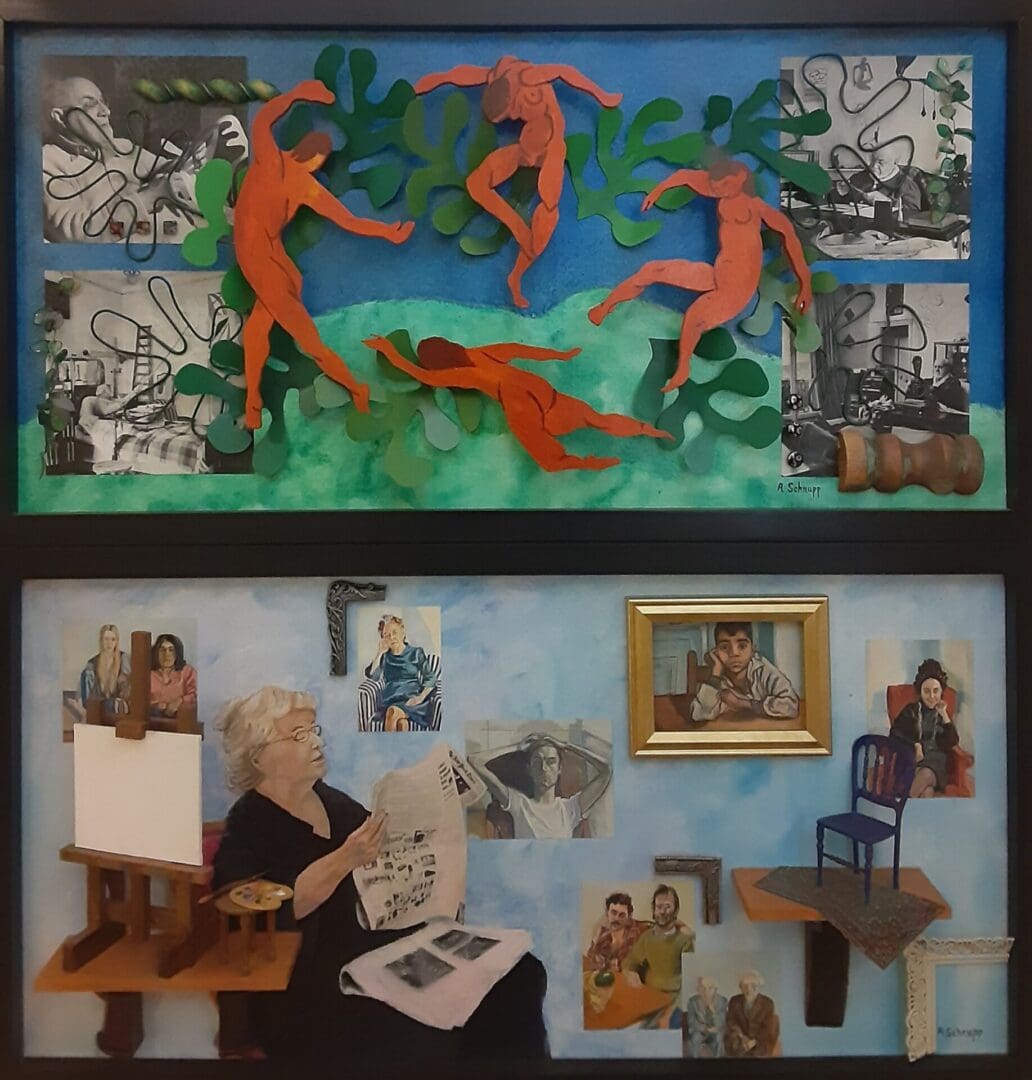
Coupled with theatrical ventures and writing, were the visual arts. Over the course of many years, I created a series of assemblages inspired by plays, a series of embellished portraits of writers and poets, a series of shrines to visual artists, a series of ceramic figurines. All these pursuits within the arts were healing ventures. Words, images, imaginings helped integrate my maturing self with the younger, wounded version of myself. Random, disquieting incidents were replaced with crafted stories. I found plot where there seemed to be no sense of direction. I discovered or manufactured theme from chaos. And in the process hurt, through the arts, was transformed into healing.
Al Schnupp is the author of Goods & Effect