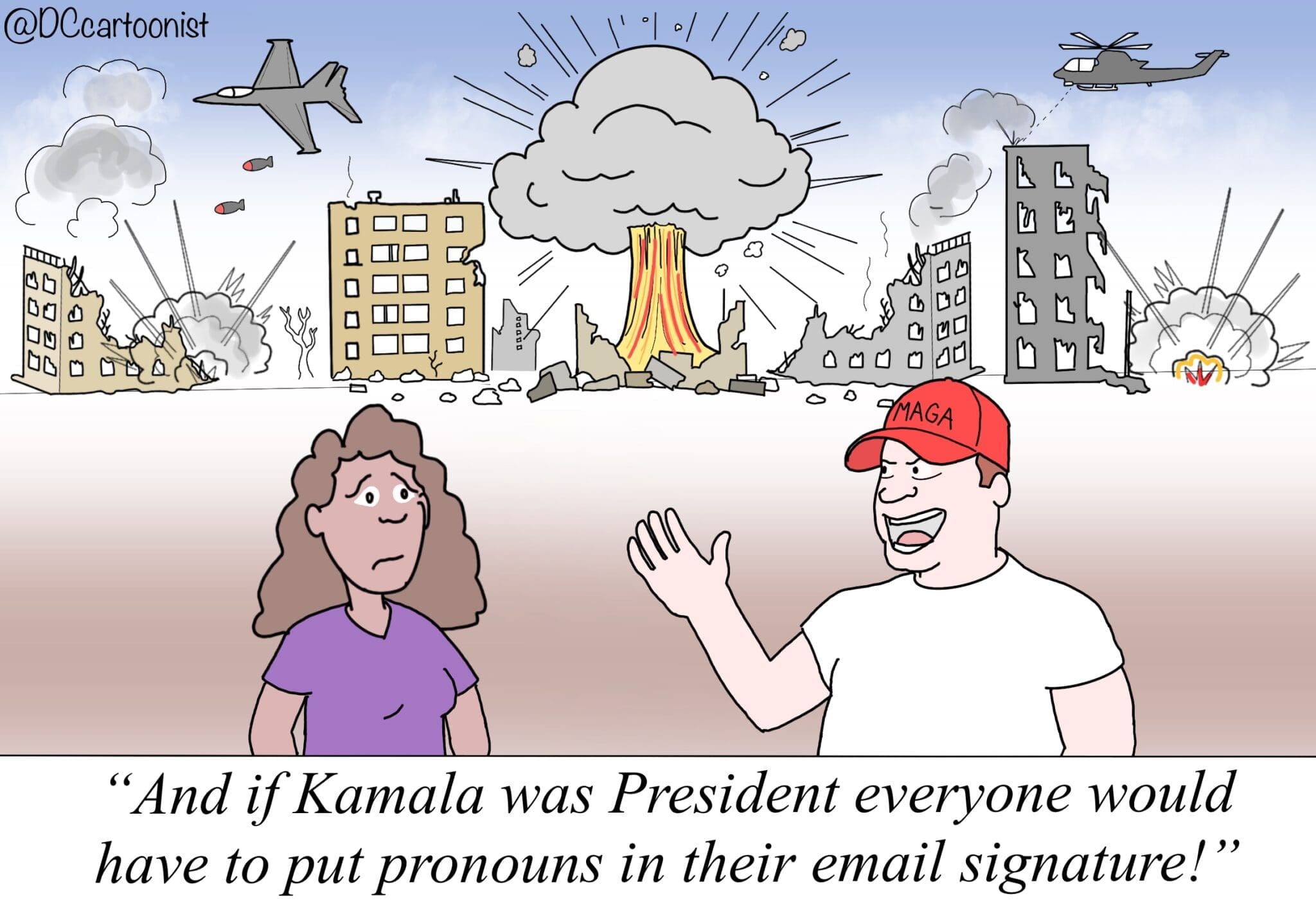
But what about pronouns?
It is hard to overstate the whiplash. Donald Trump campaigned as the candidate who would end “endless wars” in the Middle East, only to initiate a direct military confrontation with Iran. Along the way, he warned voters that Kamala Harris would drag the United States into World War III, calling her too incompetent to manage global tensions. Yet it is Trump, not Harris, who has brought the country to the brink of a wider regional conflict.
So what changed? Not much. The stated justifications have shifted with the political winds: regime change, stopping a nuclear weapon, preventing an imminent attack. Each rationale is presented with urgency, then quietly replaced by another when scrutiny sets in. The result is not a coherent strategy but a moving target, one that makes it difficult for the public to evaluate the true costs and objectives of this conflict.
Those costs are already mounting. Iran’s leadership remains firmly in place, and in some respects more entrenched than before. The Islamic Revolutionary Guard Corps has tightened its grip domestically, using the conflict to justify crackdowns and consolidate power. Economically, the fallout has rippled far beyond the region. Disruptions around the Strait of Hormuz—a critical artery for global energy supplies—have driven instability in oil and fertilizer markets, with consequences that reach American consumers.
Then there is the nuclear question, long invoked as a looming threat. For decades, Iran’s potential pursuit of a nuclear weapon has been treated as an imminent danger, yet it has not materialized into an actual arsenal. Military escalation may not deter that outcome; it could accelerate it, giving hardliners within Iran a stronger argument for pursuing nuclear capabilities as a form of deterrence.
Perhaps most striking is the muted reaction among Trump’s political base. For many supporters, foreign policy has never been the central concern. Cultural grievances—over identity, language, and social change—often dominate the conversation. The contradiction between anti-war rhetoric and pro-war action is either overlooked or rationalized away.
That indifference carries risks. When political loyalty outweighs accountability, policy becomes unmoored from principle. The question is not simply whether this war was justified, but whether voters will demand consistency from leaders who promised one path and delivered another.
In the end, many of Trump’s voters seemed far more preoccupied with cultural flashpoints—like the idea that a liberal such as Kamala Harris might push the use of pronouns in email signatures—than with the realities and risks of foreign wars.